Skip to content

Retrieval-Augmented Generation (RAG) for Businesses

With RAG, companies can securely connect their internal knowledge to AI applications and use it to generate more accurate answers.

Database Documents ERP CRM SharePoint

What is Retrieval-Augmented Generation (RAG)?

Retrieval-Augmented Generation (RAG) is an AI technique that connects a large language model (LLM) to external knowledge sources, allowing it to generate answers based on relevant and up-to-date information.

Instead of relying solely on the information learned during training, the language model can use RAG to access external documents, databases, images and other data sources. Before generating an answer, the system retrieves relevant information from the connected sources and provides it to the language model as additional context.

For a more technical explanation of how RAG works, including document chunking, vector databases and similarity search, see our glossary article on RAG.

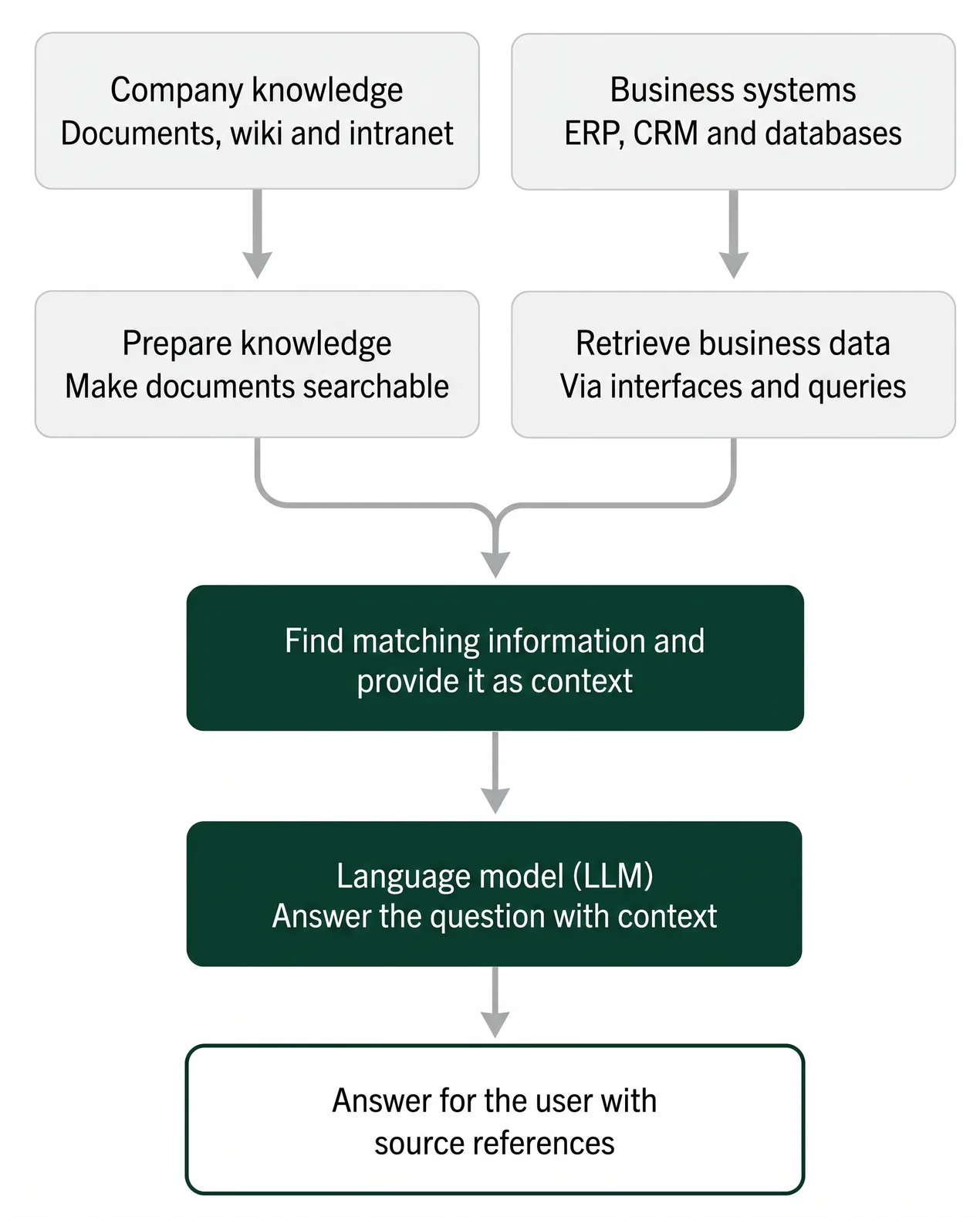
How Retrieval-Augmented Generation works: company knowledge and business systems are prepared, matching information is passed to the language model as context, answer with source references
How Retrieval-Augmented Generation works: Company knowledge and business data are retrieved and provided to the language model as context, allowing it to generate answers with source references.

What are the benefits of RAG?

Retrieval-Augmented Generation (RAG) enables language models to retrieve information from external sources and use it to generate more accurate and context-aware answers. This provides three key benefits:

  1. Reduce hallucinations

    By providing the language model with relevant documents and information, RAG significantly reduces the risk of generating incorrect or fabricated facts. However, hallucinations cannot be eliminated entirely.

  2. Incorporate company-specific knowledge

    RAG allows language models to use information that was not included in their original training data. This can include internal company documents, user preferences, operating instructions or contracts.

  3. Keep information up to date

    A language model's training data is fixed at the time of training. RAG allows applications to retrieve updated information from connected sources and include it in each request without retraining the model.

Which data sources can be connected to RAG?

Retrieval-Augmented Generation (RAG) can connect language models to a wide range of data sources. In addition to traditional documents, companies can integrate information from business systems such as ERP, CRM and databases. The main requirement is that the data can be accessed and prepared for processing by the language model.

In practice, these sources can be divided into three categories:

How these sources are connected depends on the type of data. Documents are often divided into smaller sections and made searchable through a vector database. Structured information from ERP or CRM systems, on the other hand, can be retrieved directly through APIs or database queries. Both approaches can be combined within a single RAG application.

Data sources for RAG by category, data source and examples
Data SourceExamples
1.Documents and Knowledge Sources
Documents PDF, Word, PowerPoint, TXT, Markdown
Knowledge Platforms SharePoint, Confluence, Notion, internal wikis
Communication Outlook, Gmail, Microsoft Teams, Slack
Support Systems Jira, Zendesk, internal ticketing systems
2.Business Systems and Structured Data
ERP Systems SAP, Microsoft Dynamics, Business Central, Odoo
CRM Systems Salesforce, HubSpot, Microsoft Dynamics
Databases PostgreSQL, MySQL, MongoDB, SQL Server, internal servers
Spreadsheets Excel, CSV, Google Sheets
3.External and Real-Time Data Sources
Websites Company websites, public knowledge portals
Web APIs External APIs, weather data, financial market data, economic indicators
Search Engines Google Search, Bing Search
News Sources RSS feeds, news websites

How can databases and company knowledge be connected to RAG?

Company knowledge is stored in many different formats. Business KPIs, for example, are often stored in relational databases used by ERP, CRM or data warehouse systems. Connecting these databases to Retrieval-Augmented Generation (RAG) requires a different approach from processing traditional documents. While documents such as PDFs are typically searched using semantic search, databases contain structured information with defined relationships between individual records.

There are three main technical approaches to making this information accessible to language models:

  1. Text-to-SQL: Querying databases using natural language

    With Text-to-SQL, a language model automatically converts a user's question into an SQL query. The query is executed against the connected database, and the language model uses the results to generate an answer.

    For example, a managing director might ask: “How much revenue did we generate from product X last month?” The AI generates the appropriate database query, retrieves the sales figures and presents the results as a written answer or a chart. This approach is particularly useful for financial controlling and business reporting.

  2. Vector databases: Searching information by meaning

    This approach converts text-based information from a relational database into embeddings. These allow information to be retrieved based on its meaning rather than relying solely on specific keywords.

    Technologies such as the open-source PostgreSQL extension pgvector or vector search services available through Microsoft Azure can be used to implement this approach. This makes it possible to combine traditional database queries with semantic search.

    For example, a user could search for products that meet a specific requirement based on their description and cost less than €50 at the same time.

  3. Graph RAG: Identifying complex relationships between data

    Graph RAG represents information and the relationships between individual data points in a knowledge graph. Existing tables and foreign key relationships from relational databases can be used as a starting point.

    Technologies such as Neo4j make it possible to query these relationships directly. For example, an employee might ask: “Which customers have purchased products supplied by the same supplier as product Y?” The AI can use the relationships between customers, products and suppliers to retrieve the relevant information and generate an answer.

Technical implementation with frameworks

Frameworks such as LangChain and LlamaIndex are commonly used to develop these applications. They simplify database integration, the processing of user requests and the retrieval of information that is provided to the language model.

These approaches can also be combined. The most suitable technology depends primarily on the structure of the available data and the intended use cases.

Develop RAG systems with rwQUANTICAL

rwQUANTICAL supports companies in developing and implementing custom RAG systems. Our AI engineers connect existing language models to your internal documents, databases and business systems. We support you from the initial requirements analysis through technical implementation to production operation.

Whether RAG is the right technology for your use case is something we assess together as part of our AI consulting.

Lucas Rachner
Lucas Rachner Managing Director, Digitalization & AI at rwQUANTICAL

What are the use cases for RAG in enterprise AI applications?

Retrieval-Augmented Generation (RAG) is used whenever AI applications need access to information that was not included in a language model's original training data. There are numerous applications for this within businesses:

Internal knowledge bases

Employees can ask questions about internal processes, policies or operating instructions and receive answers based on existing company documents. Common examples include AI onboarding chatbots and internal knowledge platforms that make company knowledge easier to access and reduce the time employees spend searching for information.

AI chatbots in customer service

Customer inquiries can be answered automatically using product information, manuals or FAQs. The language model retrieves information from the company's own documents to provide accurate, up-to-date and context-aware answers. In technical support, RAG-based chatbots can also handle more complex customer questions, reducing the workload for service teams.

Document analysis

Contracts, technical documentation and reports can be searched and analyzed using AI. RAG makes it possible to retrieve specific information from large collections of documents and use it for further processing. For example, companies can compare contract terms, identify relevant clauses or summarize technical information from multiple documents.

AI assistants for employees

AI applications can access information from different business systems, including CRM, ERP and SharePoint, and use it to answer employee questions. In financial controlling, RAG-based AI agents are also becoming an alternative to traditional static reporting. Employees can request specific KPIs in natural language and receive the results as a written answer or a chart.

Business process automation

RAG provides AI applications with the background information they need to automate business processes. For example, incoming emails can be classified based on internal guidelines, customer inquiries can be assigned to the appropriate contact person, and information from multiple systems can be combined. When integrated with AI agents, RAG can also support the automation of more complex business processes.

AI knowledge management and process documentation with Q-Know

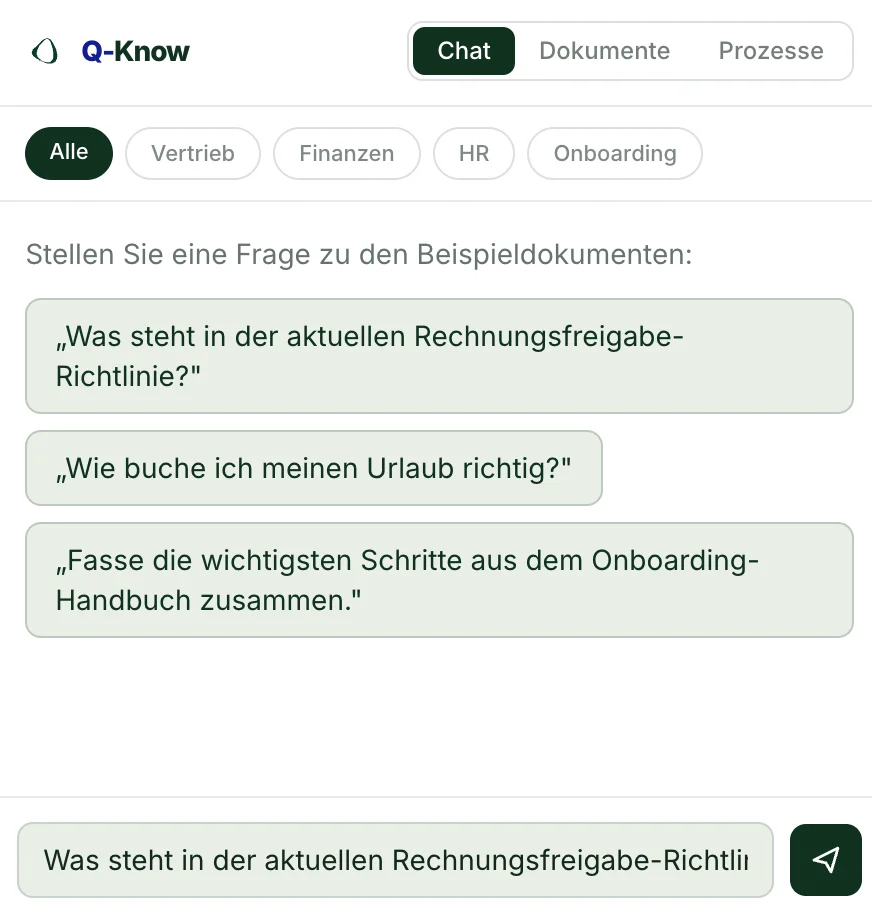
Internal knowledge management is a common use case for RAG. With Q-Know, rwQUANTICAL has developed its own software that helps companies capture, organize and make internal knowledge accessible to AI applications. Employees can ask questions about internal documents, policies or business processes and receive answers based on the available information, including references to the original sources.

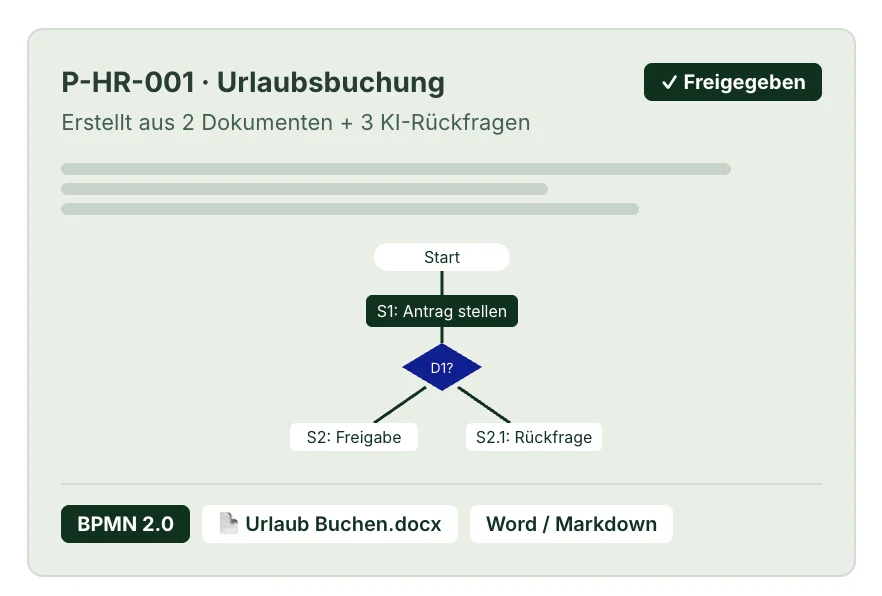
Q-Know goes beyond traditional AI-powered knowledge search. The software automatically generates process documentation and flowcharts based on the BPMN 2.0 standard. It identifies missing information, asks targeted follow-up questions and detects inconsistencies between documents. Existing business systems such as ERP platforms or data warehouses can also be connected through custom integrations.

Learn more: Q-Know, AI Knowledge Management and Process Documentation

Q-Know chat: questions about internal documents with filters for sales, finance, HR and onboarding Q-Know process documentation: process P-HR-001 vacation booking as a BPMN 2.0 diagram, created from two documents and three AI follow-up questions

What is the difference between RAG and fine-tuning?

Retrieval-Augmented Generation (RAG) and fine-tuning are two different ways of adapting existing language models to a company's requirements. Fine-tuning changes the model itself through additional training, while RAG supplies the model with additional information at every request. The two approaches therefore pursue different goals.

Fine-tuning

The language model learns how it should answer.

  1. Preparation

    Train the model

    The language model is trained with examples to learn a specific writing style or answer format.

  2. User request

    Ask a question

    The user asks a question. The model answers it based on its trained capabilities.

  3. Language model Fine-tuning acts here

    Adapted model

    The model has been changed through additional training and applies the learned answer patterns.

  4. Answer

    In the desired style

    The AI answers in the trained style without automatically accessing current company data.

RAG

The language model receives additional information to answer questions.

  1. Preparation

    Connect data sources

    Company documents, databases and other knowledge sources are connected to the AI application.

  2. User request RAG acts here

    Retrieve information

    For every question, matching information is searched for in the connected sources and provided.

  3. Language model

    Unchanged model

    The language model processes the question and the provided information without additional training.

  4. Answer

    Based on the sources

    The AI answers the question using the retrieved information and can state the sources it used.

Combining fine-tuning and RAG

The language model answers in the desired style and uses current company information.

  1. Preparation

    Train the model and connect data

    The language model is trained for the desired answer style. Company data is connected as well.

  2. User request RAG

    Retrieve information

    The AI searches the connected sources for matching information and adds it to the user's question.

  3. Language model Fine-tuning

    Adapted model

    The trained language model processes the provided information and formulates the answer in the desired style.

  4. Answer

    In the desired style, with sources

    The AI combines the trained style with the retrieved company information.
Fine-tuning changes how a language model answers. RAG provides additional information on which the answer is based. Both approaches can be combined.

Fine-tuning: adapting how a language model behaves

Fine-tuning continues the training of an already trained language model with additional data, often in the form of input-output pairs. The model receives a question together with the desired answer, for example, and learns to produce similar answers to comparable requests.

A typical use case is adapting the writing style. A company can train a model to answer customer inquiries in a specific tone. Fine-tuning also improves adherence to specific answer formats, terminology or behavior.

A model can learn additional domain knowledge through fine-tuning, but the approach is only partially suitable for providing current and precise company information. The information is not stored as individual documents; it changes the model's internal parameters. There is no reliable way to ensure that the model reproduces learned facts correctly, and fine-tuning does not fundamentally prevent hallucinations.

RAG: supplying a language model with company knowledge

Retrieval-Augmented Generation (RAG) takes a different approach. The existing language model is not trained further. Instead it receives relevant information from connected data sources before it generates an answer.

If an employee asks “What was our revenue last month?”, the RAG system retrieves the relevant figures from a connected database and provides them to the model as context. The model then formulates an answer based on that information.

The language model keeps its original language capabilities and answer style. Unlike fine-tuning, it is given specific information that was not available during its original training.

A key advantage is currency. When new documents are stored in SharePoint or revenue figures are updated in the ERP system, this information can flow directly into future answers, provided the sources are connected. Retraining the model is not required.

The risk of hallucinations is also reduced, because the AI can base its answers on concrete sources. It does not rule out incorrect answers entirely.

Can fine-tuning and RAG be combined?

The two approaches are not mutually exclusive. In enterprise applications it can make sense to combine fine-tuning and RAG.

A customer service chatbot could be fine-tuned to answer in the company's preferred style, while RAG ensures that it has access to current product information, manuals or contract terms.

In that setup, fine-tuning mainly determines how the AI answers. RAG provides the information the answer is based on.

For companies that want to connect their existing documents, databases or business systems to language models, RAG is therefore the more sensible starting point in many cases. Fine-tuning is a useful addition when the behavior or the form of a model's answers needs to be adapted specifically.

Build a RAG system for your company

Together we check which knowledge sources are suitable for RAG and build the solution from a prototype with your real data to production.