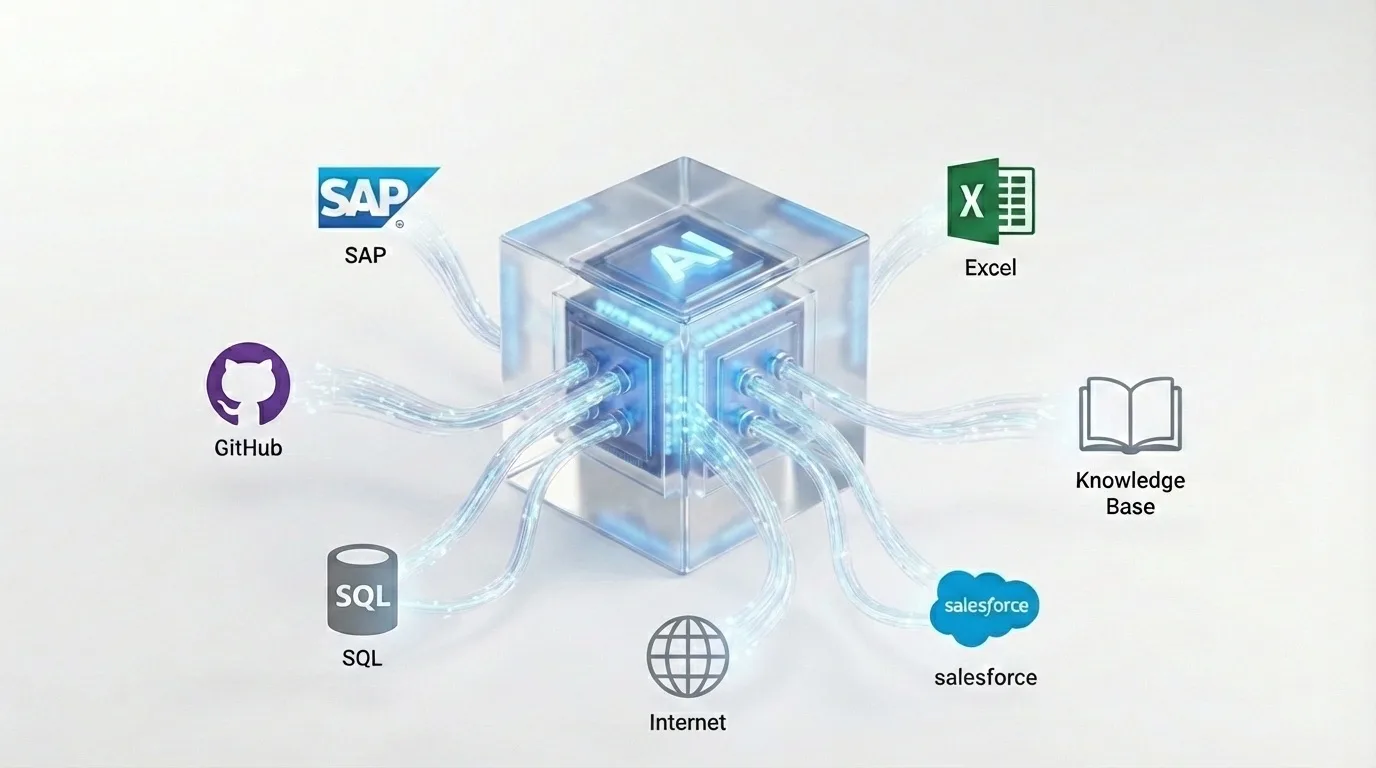
Last week I sat in a client's accounts payable department. Four people, eight screens, a printer that would not stop. Their job: manually entering 1,200 incoming invoices per month into SAP. Retyping header data, matching line items, checking account assignments. Every. Single. Document.
This team is not slow. They are trapped in a process that artificial intelligence handles in seconds. And they are not an outlier. 72% of German mid-sized companies cite talent shortages as their biggest growth constraint, while their teams spend 30–40% of working hours on exactly these kinds of tasks.
This article covers ten processes where AI automation delivers the fastest payback. With ROI figures from our projects. And three processes where we advise against it, even when clients initially push back on hearing that.
Why AI Automation Belongs on Your Agenda Now
The roles nobody applies for anymore
Germany will face a shortfall of 4.2 million workers by 2030. Baby boomers are leaving, and nobody voluntarily applies for accounts payable data entry. The answer is not to recruit faster. The answer is to automate repetitive work and redeploy existing staff where they need judgment.
The technology delivers on its promises
Two years ago, we recommended large language models with caution. Too many hallucinations, too little control. That has changed. Invoices now get read with 97% accuracy. Emails classified in milliseconds. SAP reports generated in seconds. The models are ready. What is often missing is the bridge to the business process.
Those who wait pay twice
Rising labor costs plus ground lost to competitors who have already rebuilt their processes. We see this in tenders: companies that have automated quote 15–20% lower. Not because they work cheaper, but because there is less manual labor in their cost base.
How We Evaluate Processes for AI Automation
Not every process is worth automating. Before recommending AI implementation in a project, we score four dimensions. The table looks simple. But it has saved us from expensive missteps.
| Dimension | Question | Ideal value |
|---|---|---|
| Volume | How often does this process run per week? | > 50 instances/week |
| Data maturity | Is input data digital and structured? | Digital documents, APIs |
| Error rate | What is the current error rate? | > 3% (room for improvement through AI) |
| ROI horizon | When does the investment pay back? | < 6 months |
A process that scores well across all four dimensions gets automated first. A process with high volume but poor data quality needs groundwork before any AI touches it. And a process that runs five times a week rarely pays off, no matter how elegant the solution.
10 Processes With the Fastest ROI
1. Invoice processing
The classic, and number one for good reason. AI reads incoming invoices, whether PDF, scan or email attachment, extracts header and line-item data and posts directly to the ERP system.
The chemical distributor I mentioned at the start now processes 85% of its 1,200 monthly invoices without human intervention. The accounts payable team went from four people to one. The other three? They now work on liquidity planning and supplier management. Activities that move the company forward instead of just keeping it running.
ROI: 200–400%. Payback in 8–14 weeks.
Prerequisite: Invoices available digitally. SAP or ERP interface in place.
2. Email classification and routing
This one gets underestimated. An industrial supplies wholesaler received 400 emails per day at info@. Orders, complaints, price inquiries, job applications, spam. Two employees spent every morning sorting.
Since deploying an n8n workflow with OpenAI integration, the AI reads every incoming email, identifies intent and routes accordingly: orders to inside sales, complaints to quality assurance, applications to HR. Throughput times dropped by 60%. Not because processing got faster, but because nothing sits in the wrong inbox anymore.
ROI: 100–200%. Payback in 4–6 months.
3. Procurement quote comparison
Sound familiar? The buyer receives eight quotes as PDFs, opens each one, transfers prices, lead times and terms into a spreadsheet, flags deviations from specs. Four hours of work per tender.
At a machinery manufacturer near Stuttgart, we cut that to 20 minutes. The AI extracts the relevant fields, normalizes the data and builds the comparison matrix. The buyer reviews and decides. Instead of typing.
ROI: 150–250%. Payback in 3–4 months.
Especially relevant in manufacturing and trade with many suppliers.
4. Quality control with computer vision
This process has the highest ROI on the list but also demands the largest upfront investment. Camera systems with computer vision inspect surfaces, dimensions and assembly states faster and more accurately than the human eye.
An automotive supplier was struggling with a 4.2% scrap rate. After deploying a vision system, the rate dropped to 2.7% in the first quarter. On EUR 18M annual revenue, that means EUR 270,000 less scrap. The camera installation including model training cost EUR 85,000.
ROI: 250–500%. Payback in 3–6 months.
5. Reporting and dashboards
Same picture in controlling every month: SAP exports, CRM data, spreadsheet gymnastics, PowerPoint assembly. Three person-days for the monthly report. AI agents do it in minutes.
At a logistics provider with 200 employees, the monthly report now lands on the desk on business day 2 instead of day 10. Not because someone types faster, but because the data gets pulled, aggregated and annotated automatically. The controller reviews and adds interpretation. How AI agents in the enterprise are built is something we cover with concrete examples.
ROI: 180–300%. Payback in 2–4 months.
6. Customer support triage
An AI-powered system reads incoming support tickets, classifies by category and urgency, and routes to the responsible team. In under two seconds. This does not eliminate roles. But it saves the 20 minutes per ticket that a dispatcher otherwise spends reading and assigning.
Viable from 200 tickets per month. Below that threshold, the manual effort is manageable.
ROI: 120–180%. Payback in 3–5 months.
7. Document extraction
Delivery notes, certificates, technical data sheets. Hundreds of documents per week, with individual fields transferred manually into systems. That takes time. And it causes errors that only surface weeks later, when wrong specifications reach the production floor.
AI-powered extraction achieves 92–97% field accuracy after brief training. At a building materials wholesaler processing 300 delivery notes per week, the error rate dropped from 6% to below 1%.
ROI: 200–350%. Payback in 10–16 weeks.
8. Contract analysis
50 pages of framework agreement. Somewhere on page 37, a clause specifies a 2% per week penalty for late delivery. The buyer missed it. This happens more often than you think.
AI scans the entire contract in seconds and flags risk areas, deadlines and deviations from your standards. An IT services company cut its contract review from 3 hours to 20 minutes per contract. The AI does not replace legal judgment, but it ensures nothing gets overlooked.
ROI: 150–300%. Payback in 3–5 months.
9. Onboarding workflows
The underestimated process. New hires need a laptop, access credentials, training dates, signatures, briefings. At most companies, someone in HR coordinates this via email and sticky notes. Things regularly fall through the cracks.
AI orchestrates the entire sequence: creates IT tickets, books training rooms, sends checklists to the hiring department. At a company with 150 hires per year, this saves 12 working days. More importantly: new employees are productive on day one instead of day three.
ROI: 80–150%. Payback in 4–6 months.
10. Master data maintenance
Not glamorous. But it affects everything else. Duplicate customer numbers, missing postal codes, outdated contacts. When your master data is dirty, every analysis returns wrong results. Every AI built on top of it learns nonsense.
A food industry mid-sized company had 45,000 customer records. The duplicate rate was 8%. Eight percent. After an AI-powered cleanup project: 0.3%. That sounds like hygiene, not strategy. But without clean master data, every downstream project fails, from predictive analytics to AI strategy.
ROI: 100–200%. Payback in 4–6 months.
3 Processes Where We Actively Advise Against Automation
We make our money with AI projects. Yet we say no to certain use cases. That costs revenue in the short term but preserves trust.
Strategic negotiations
AI can prepare negotiations: deliver data, model scenarios, draft counteroffers. But at the negotiating table, what counts is reading people. When do you stay silent? When do you concede on one point to win on another? No model can do that. Automate this and you lose clients.
Creative product development
Generative AI creates drafts and variations. Sometimes usable ones. But genuine product innovation comes from market understanding, customer feedback and the willingness to build something that does not exist yet. That is not an automation problem.
Compliance with high liability exposure
GDPR data subject requests, export controls, regulatory filings. AI can pre-screen and flag. But the final decision must rest with a human. A single export control mistake can cost a company millions. Our recommendation: AI as pre-screening. Human as sign-off. Always.
How to Get Started With AI Automation
Not with the technology. Not with a tool comparison. Start with three questions:
- Where does your team burn the most time on repetitive work?
- Where is the data for that already available digitally?
- Where would the impact on cost or throughput time be greatest?
If you can answer all three, you have your first use case. From there, three steps:
- Potential analysis (2–3 weeks): An experienced AI consultant evaluates your processes, data quality and IT landscape. Result: a prioritized use-case list with ROI estimates.
- Proof of concept (3–4 weeks): The most promising process gets built as a prototype. With your real data, not demo data.
- Rollout (4–8 weeks): Production environment, system integration, team training. In this phase, AI engineers for implementation handle the technical integration.
10–16 weeks. That is how long it takes from first analysis to a running process. Not months. Not years.
Frequently Asked Questions About AI Automation
How much does AI automation cost for mid-sized companies?
A single process: EUR 15,000–60,000 for analysis, development and integration. Most processes pay back within 6 months. A potential analysis starts at EUR 5,000.
Which processes are best suited?
High volume, clear rules, good data quality. Classic entry points: invoice processing, email routing, support triage, reporting. If the process is repetitive enough that staff describe it as boring, it is probably a good candidate.
Do I need an in-house IT department?
No. Many of our mid-market clients do not have one. They start with us as an implementation partner and take over operations gradually. Tools like n8n or Power Automate lower the technical barrier considerably.
How long until it goes live?
6–12 weeks for the first process. SAP integrations take 3–4 months. The bottleneck is rarely the technology. It is alignment with business departments.
This Is Not Future Talk
Ten processes. All with payback under six months. No research projects, no five-year plans. Business processes that run manually today and can be automated within three months.
Mid-sized companies have an advantage here that corporations do not: shorter decision paths and teams that adopt new tools because they feel the relief. Not because a corporate strategy says so. We cover which automation use cases newly start to pay off in our AI newsletter.
Want to know which processes in your company have the highest automation ROI? Talk to us. We identify the quick wins in a potential analysis. Honest, concrete and backed by numbers.