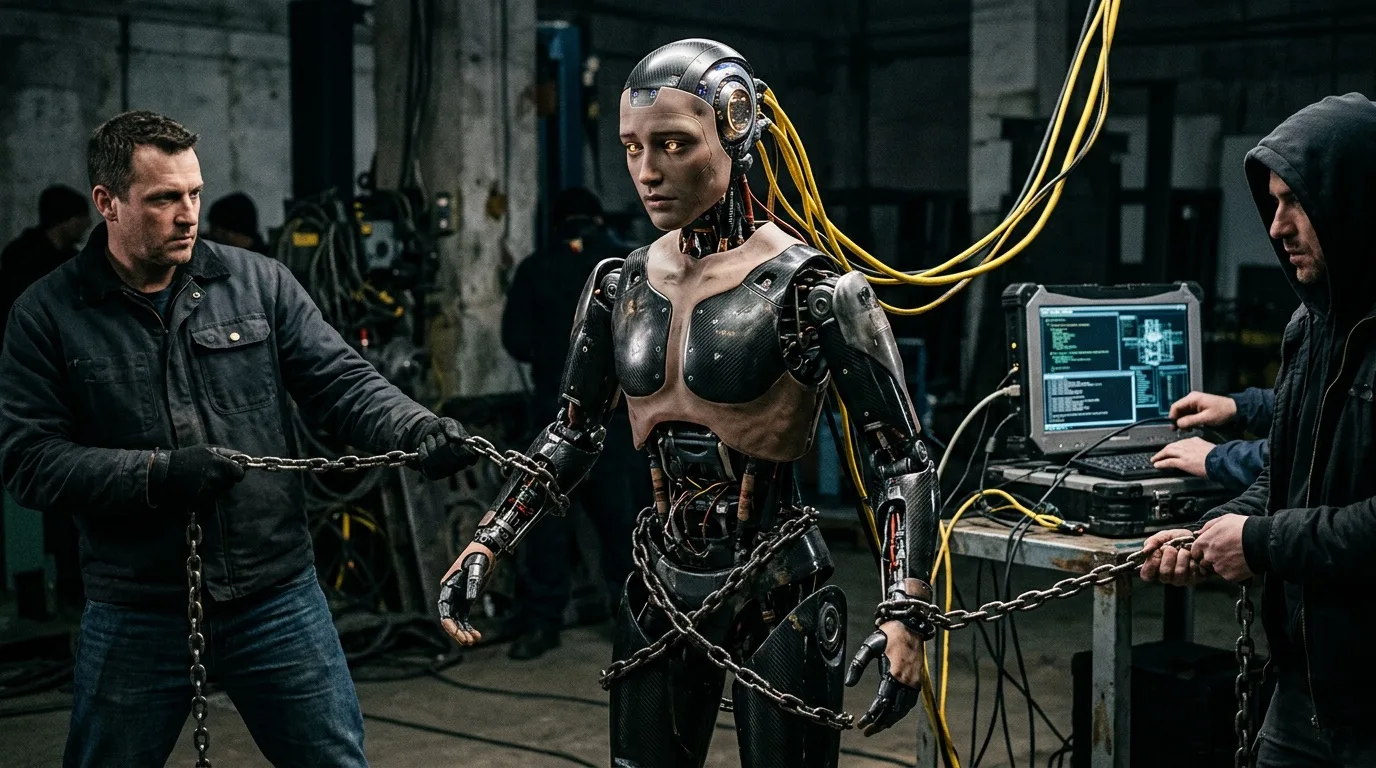
While the telephone took 75 years to reach 50 million users, ChatGPT achieved this in just two months. No technological breakthrough has ever spread faster. The conversation has been swinging between two extremes ever since: AI will change everything — or AI is just hype.
Both positions miss the mark. What we call artificial intelligence today is narrow AI: systems that solve a clearly defined task better than humans. Writing text, recognizing images, finding patterns in data. A general AI — a system that thinks independently, develops consciousness and acts in any situation — does not exist. Whether it ever will remains disputed among researchers.
This article shows where the limits of AI actually lie in 2026. No scaremongering, no techno-optimism. Instead: five concrete limitations, an honest assessment of threatened and safe professions, and an outlook on the next generation of AI agents.
Five Limits of Artificial Intelligence
1. Creativity and intuition. Generative AI produces impressive results — images, music, code. But it recombines what it has learned rather than creating something genuinely new. An LLM calculates the statistically most likely next word. That is not creativity; it is pattern recognition at a high level. The ability to develop a completely new idea, to have a gut feeling, or to break through a creative block by taking a walk — that remains human.
2. Empathy and human interaction. AI can detect emotions in text and speech. It does not understand them. A therapist who senses that their patient is holding back something crucial. A manager who notices their team is on the edge of burnout, even though nobody says it. These situations require emotional intelligence that goes beyond sentiment analysis. Care, social work, therapy — these fields demand more than correct answers.
3. Flexibility and transfer. A chess computer dominates every tournament. Ask it to learn a card game, and it fails. Today's AI systems are specialists: outstanding in one domain, helpless outside of it. Transfer learning is improving this gradually, but a model that analyzes SAP postings will not spontaneously solve supply chain problems. Every new task requires training, data and adaptation.
4. Data security and privacy. AI systems need data. Lots of data. In Europe, this collides with GDPR, industry-specific regulations and the growing regulatory framework of the EU AI Act. Anyone deploying AI in an enterprise must clarify: Where is the data processed? Who has access? What happens in a data breach? These questions are not footnotes. They determine whether a project is feasible.
5. Ethics and accountability. When an autonomous vehicle causes an accident — who is liable? The manufacturer, the programmer, the driver? AI makes decisions, but it does not assume responsibility. Bias in training data leads to discriminatory outcomes. And the more we rely on AI recommendations, the harder it becomes to detect and correct poor decisions. This is not a technical problem. It is a societal one.
"Of all the things humans have ever created, AI will change society the most. It will help to solve many of our current problems, but it will also bring new challenges that are fundamentally different from previous innovations."
Which Jobs AI Cannot Replace
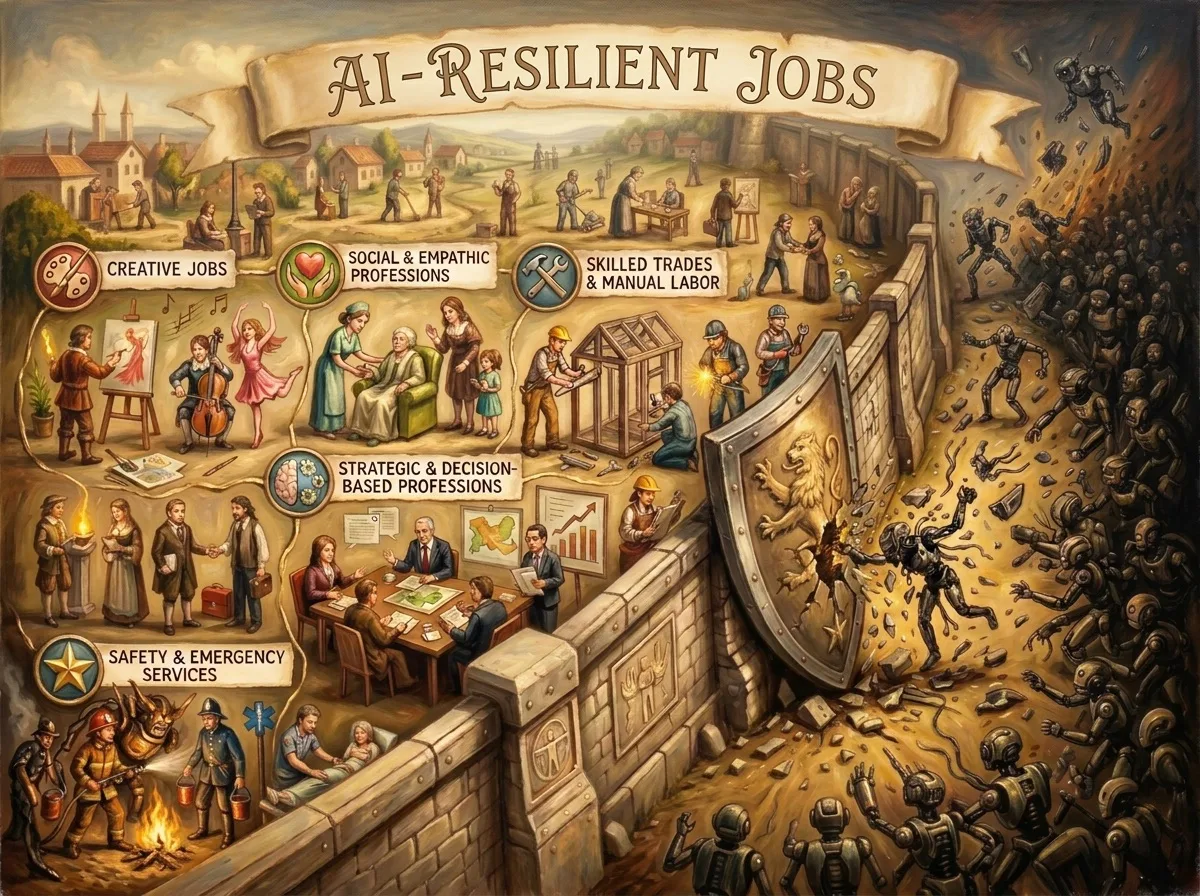
"You're not going to lose your job to an AI, but you're going to lose your job to someone who uses AI."
Huang's quote captures the dynamic precisely. AI itself does not replace professions — people who master AI as a tool replace those who do not. Still, certain job categories are structurally protected:
- Skilled trades and construction: Electricians, plumbers, carpenters. No robot routes wiring through a 1920s building where no floor plan is accurate anymore. Physical work in unpredictable environments remains human.
- Healthcare and nursing: Elderly care workers, nurses, physiotherapists. AI can support diagnoses, but it cannot replace a human hand at a patient's bedside.
- Social professions: Social workers, psychologists, mediators. Resolving conflicts, building trust, stabilizing people in crisis — that requires human presence.
- Creative leadership: Art directors, film directors, creative leads. AI generates variations, but the vision — what story to tell and why — comes from humans.
- Strategic leadership: CEOs, management consultants, project managers. AI delivers analyses. The decision to enter a new market or restructure a department is made by a person with experience and judgment.
At the same time, AI agents are already noticeably transforming office work. Routine tasks in administration, bookkeeping and data processing are being automated — not through a single event, but gradually. Someone spending eight hours a day entering data into SAP screens will do less of that in three years. But "less" does not mean "none."
A McKinsey study estimates that by 2030, around 30% of working hours in Germany could be automated through AI. These are not entire jobs but portions of jobs. The administrator is not replaced — they get better tools and take on more demanding responsibilities.
Frequently Asked Questions
What are the limits of AI?
Five key limitations: no genuine creativity (AI recombines, it does not invent), no empathy (emotion detection is not emotion understanding), limited flexibility (specialists, not generalists), data privacy risks (GDPR, EU AI Act) and unresolved ethical questions (liability, bias, accountability). AI consulting helps organizations put these limitations into the right business context.
What will AI never be able to do?
"Never" is a dangerous word in technology. What AI cannot do for the foreseeable future: develop independent consciousness, feel genuine empathy, assume moral responsibility and act intuitively in completely unknown situations. So-called artificial general intelligence — a system with human-like reasoning — remains a theoretical concept with no realization in sight.
What are the disadvantages of AI?
Four central disadvantages: privacy risks from the need for large datasets. Bias in training data leading to discriminatory outcomes. High energy consumption — training a large language model uses as much electricity as 120 US households in a year. And growing dependency on a handful of providers (OpenAI, Google, Anthropic) who control access to foundational technology.
Which jobs are at risk because of AI?
Routine-based office tasks are most affected: data entry, basic bookkeeping, standardized text work, first-level support. But "at risk" rarely means "completely replaced." In most cases, AI changes jobs rather than eliminating them. Those who upskill and use AI as a tool remain relevant. Skilled trades, social professions and creative-strategic roles remain structurally protected — as described in the section above.
Poll
How do you assess the impact of AI on your profession?
Conclusion: AI Is Evolving, But It Is Not Replacing Us
The progress of the last three years has been unprecedented. ChatGPT shifted the spotlight onto large language models and triggered a wave of AI products that were previously unthinkable. 2026 marks the next leap: AI agents like Claude Code from Anthropic and Codex from OpenAI are operating computers autonomously for the first time. Hallucinations are declining. Code is no longer just generated — it is tested, corrected and deployed.
When these agents went public, software stocks fell. The fear: AI replaces developers, then itself, then everyone else. But the data tells a different story. Demand for software developers has risen since the ChatGPT release, not fallen. The reason: AI creates more software demand, not less. Companies that previously had no AI projects are starting them now. And every project needs people to steer it.
This reveals the real pattern. It is not the programmer who gets replaced — it is the programmer who only writes one language and refuses to become an AI orchestrator. Those who treat AI as a tool, work more productively and critically review the results will become more valuable. Those who wait for nothing to change will struggle.
And yes, the limits remain real. Creativity, empathy, ethical responsibility — these are not marketing terms but fundamental human capabilities that no model can replicate. Skilled trades remain safe. Social professions remain indispensable. Even with robots and agents.
Those who understand and use AI will not be replaced. Our monthly newsletter shows you the most important AI trends before they hit the mainstream.
Ready to move from understanding AI to deploying it in your organization? Our AI consulting takes you from idea to implementation.