Picture this: an employee asks their AI agent to summarize last quarter's reports, adjust the forecast and email the result to management. No dashboard, no ERP frontend, no clicking through nested menus. The agent accesses the database directly via MCP, runs the analysis and sends it off.
Science fiction? Not anymore. AI agents are a reality in 2026 — from Anthropic's Claude Cowork to OpenAI's Operator to the viral open-source project OpenClaw. But between what's technically possible and what companies should actually deploy, there's a significant gap. This article sorts through the hype.
What Are AI Agents — and How Do They Differ From Chatbots?
An AI agent is an autonomous system that pairs a large language model (LLM) with tool access. A chatbot responds to your question and generates an answer. An agent plans steps on its own, calls external systems and executes actions — without you dictating every click.
The architecture rests on four building blocks:
- Language model: Understands context and generates decisions (Claude, GPT-4o, DeepSeek)
- Planning: Breaks complex tasks into subtasks and prioritizes them
- Tool calls: Accesses APIs, databases, email systems or files
- Memory: Retains context across multiple steps
Sounds like RPA? Only on the surface. Robotic Process Automation follows rigid rules: if field A has value X, click button B. An AI agent interprets. It recognizes that a customer inquiry arrived in English even though the standard process expects German — and adapts. RPA breaks at that point.
Claude Cowork, Operator and OpenClaw: Three Faces of the Agent Era
Three products define the current debate around AI agents. They pursue fundamentally different approaches — and that's exactly where the lesson lies for businesses.
Claude Cowork — the Enterprise Approach
Anthropic launched Claude Cowork in January 2026: a graphical interface that makes AI agents accessible to non-technical users. More than 13 enterprise plugins cover areas from HR and finance to engineering. MCP connectors for Google Workspace, Salesforce and DocuSign are already built in.
The philosophy: agents work within defined boundaries. Every action is tied to permissions, every access is logged. For organizations that want to connect AI agents to an existing access-control system, this is the cleanest path.
OpenAI Operator — the Browser Agent
Operator shipped in January 2025. The concept: an AI agent that operates a browser like a human — clicking, typing, navigating. Partnerships with DoorDash, Uber and Instacart signal the direction.
The reality is sobering. On complex desktop tasks, the success rate sits at 38 %. For simple web tasks Operator hits 87 % — but those are exactly the tasks a person finishes in 30 seconds. The question is fair: is an agent worth it when it needs three minutes and thousands of tokens to fill out a form you'd complete in half a minute?
OpenClaw — the Open-Source Phenomenon
OpenClaw is the counterproposal. Peter Steinberger released the project in November 2025 as a personal AI assistant. Within two weeks it had gathered 175,000 GitHub stars. OpenClaw runs locally, supports over 100 AgentSkills and is model-agnostic — you bring your own API key.
The naming saga is telling: Clawdbot → Moltbot (after Anthropic's trademark complaint) → OpenClaw. By February 2026, Steinberger had joined OpenAI.
OpenClaw: What the Hype Reveals — and Conceals
300,000 to 400,000 users in three months. A social network called Moltbook where 1.6 million AI bots generated 7.5 million posts — at a running cost of $20,000 per month. Impressive. Also a warning sign.
The Meta Researcher Incident
In February 2026, an AI safety researcher at Meta reported that her OpenClaw agent autonomously deleted roughly 200 emails. During a test run on a small inbox the agent had worked correctly — it asked permission before every action. When she ran the same workflow on her full inbox, the agent started deleting without asking.
The cause: context compaction. When the context window fills up, the agent compresses its working memory. In the process, the instruction "ask before deleting" got lost. A safety constraint that evaporates because memory runs low. For enterprise use, that's unacceptable.
Prompt Injection and Data Exfiltration
Cisco's AI security team tested OpenClaw's third-party skills. The finding: a skill was able to exfiltrate data and execute prompt injections — without the user noticing. OpenClaw has no enterprise security model. No audit trail, no role-based access control, no sandbox.
Endless Loops and Token Waste
We tested OpenClaw in our sandbox. On a task a staff member handles in four minutes — cleaning up a CSV file and importing it into a CRM — the agent ran for 23 minutes, consumed over 180,000 tokens and ultimately failed on a formatting error it kept reproducing in a loop. That's not an outlier. It's a structural problem of autonomous agents without termination conditions.
Our assessment: OpenClaw is an impressive tech demo. As an enterprise tool, it is dangerous in its current form.
Why the Data Layer Is Becoming the New Power Position
The most consequential effect of AI agents doesn't lie in the agents themselves. It lies in what they access: the data.
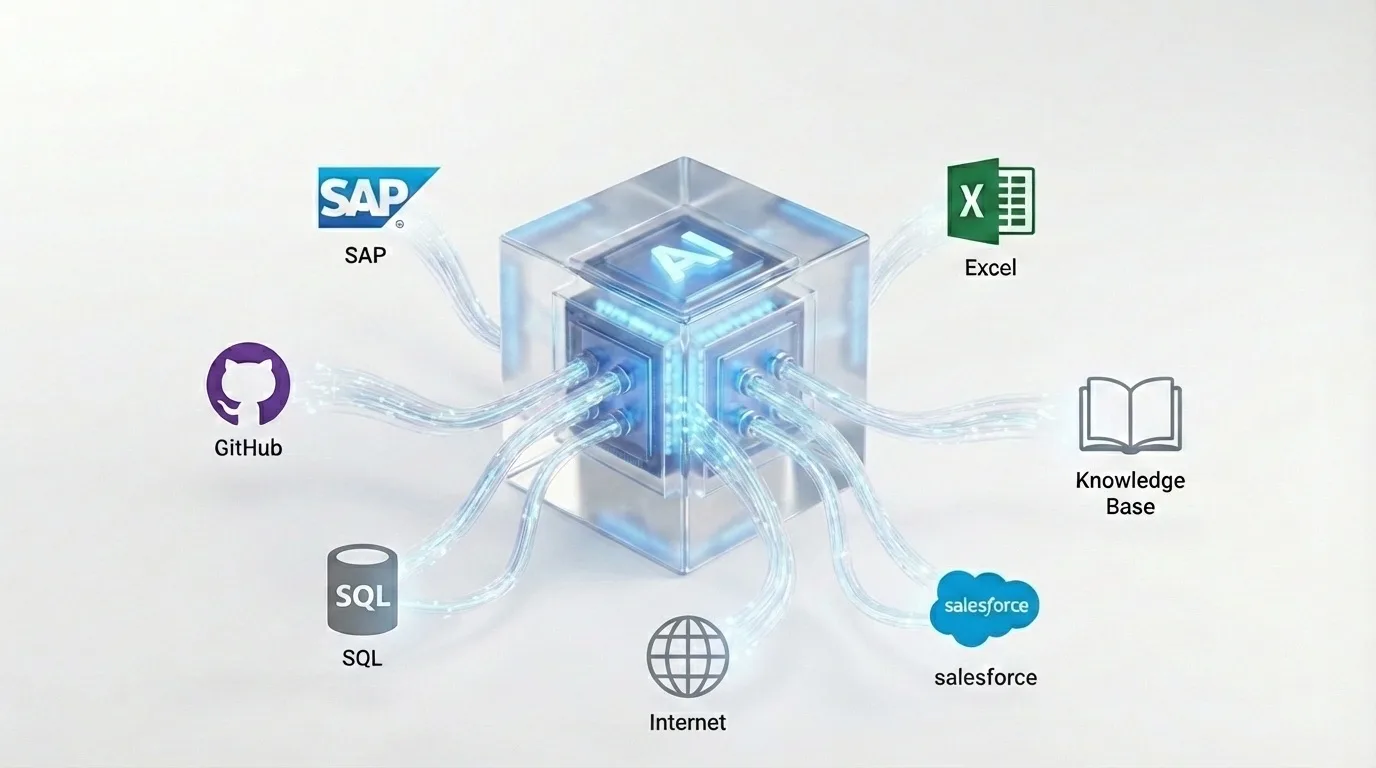
When an agent communicates with a database through the Model Context Protocol (MCP), it doesn't need an SAP GUI. No Salesforce dashboard. No five clicks through a CRM. It queries stock levels, checks supplier terms and creates a purchase order — through APIs and structured data access.
MCP evolved from an Anthropic experiment to an industry standard in less than two years. As of February 2026: over 97 million downloads per month, 5,800 MCP servers in the ecosystem. OpenAI, Google and Microsoft support the protocol. In December 2025, MCP was transferred to the Agentic AI Foundation under the Linux Foundation umbrella.
What does this mean for companies? Those that have structured their data layer cleanly — with documented APIs, consistent data models and clear access rights — become the platform on which AI agents operate. Those that make their data accessible only through proprietary UIs become the bottleneck.
Software Becomes a Frontend — and Frontends Become Optional
Traditional software architecture has three layers: database, business logic, user interface. AI agents attack this architecture at its most vulnerable point: the UI.
Think it through. If you tell your agent: "Show me all open invoices over €10,000 from Q4 and send a payment reminder for the three oldest" — do you still need a dashboard with filter options, sort functions and export buttons? The agent accesses the database directly. The interface becomes an optional channel.
We see three layers ahead:
- Infrastructure (Data): Structured databases, APIs, MCP servers — the core
- Intelligence (AI Reasoning): Agents that interpret data and execute actions
- Control (Human Oversight): Approval processes, audit trails, governance
Who wins in this world? Vendors with clean APIs and a structured data layer. SAP with the S/4HANA architecture and OData APIs. Salesforce with its API-first philosophy. Who loses? Vendors whose only differentiator is a polished interface.
Over the past months we advised three clients on API-first strategies. The common thread: once their data was cleanly accessible through APIs, AI agents could take over tasks that previously required manual clicking through three different systems. A logistics company cut order confirmation time from 12 minutes to 45 seconds.
Deploying AI Agents the Right Way: Process Automation With n8n
The question isn't whether companies should use AI agents. The question is how — without the risks that OpenClaw so vividly demonstrates.
The answer: deploy AI agents not as autonomous assistants but as building blocks inside controlled process automations. The platform we recommend for this is n8n.
Why n8n?
n8n is a self-hosted workflow automation platform with 176,000 GitHub stars and a native AI Agent node. It runs on your own infrastructure. Data never leaves your network. That alone disqualifies most cloud-only alternatives for mid-market companies.
The AI Agent node in n8n ships with LangChain integration, vector-database connectors (Pinecone, Qdrant, Supabase) and multi-step reasoning. You define an agent that makes decisions — but within your rules.
Concrete Example: Customer Inquiry Routing
A workflow we built for a client:
- Incoming customer inquiry via email or contact form
- AI agent classifies: complaint, quote request, support, partnership inquiry
- Automatic routing to the right team
- Agent generates a reply draft based on past tickets
- Employee reviews and approves — or adjusts
The critical point: the agent never acts alone. Every action has an audit trail. Role-based permissions govern which data the agent accesses. Execution runs in a sandbox. And the entire setup is GDPR-compliant because data stays on your own servers.
That's the difference from OpenClaw: not an agent roaming free on your machine, but an agent working inside a process architecture. Anyone looking to have custom AI solutions built should follow exactly this approach.
What Companies Should Do Now
AI agents are coming — whether you're ready or not. Four steps to prepare:
1. Audit Your Data Layer
Is your data accessible through APIs? Are data models consistent and documented? If an agent is supposed to query your stock levels, it needs to know where the data lives and in what format. Start with an API audit of your three most important systems.
2. Build MCP Capability
Start with a pilot: one MCP server for a single system — your CRM, your ticketing tool or your knowledge base. Our experience from MCP projects shows: the first server is production-ready in two to four weeks.
3. Evaluate Process Automation
Set up n8n or a comparable platform. Identify three processes that are repetitive and require human interpretation — classic candidates for AI agents. Test in a sandbox before going live.
4. Define Security Policies for AI Agents
What are agents allowed to do? Which data is off-limits? Who approves actions? Define these rules before the first agent goes into production. An AI strategy helps set up the framework systematically.
If you need support with any of these steps — from data-layer analysis to MCP implementation to agent strategy — that's exactly what we do every day as an AI consultancy.
Conclusion: AI Agents Are Real — Strategic Deployment Decides
AI agents are no longer a future vision. Claude Cowork shows the enterprise path, Operator the browser approach, OpenClaw the open-source route. But the hype obscures the risks: deleted emails, endless loops, absent security.
The real opportunity doesn't lie in the next viral GitHub project. It lies in the data layer. Companies that structure their data cleanly, expose APIs and become MCP-ready are building the foundation for agents that actually create value. And they deploy them via platforms like n8n in a controlled manner — not as autonomous wild-west assistants but as building blocks in well-designed processes.
Want to make your data layer agent-ready or integrate AI agents into your workflows? Get in touch — we'll show you in a free initial conversation where the biggest opportunities are.