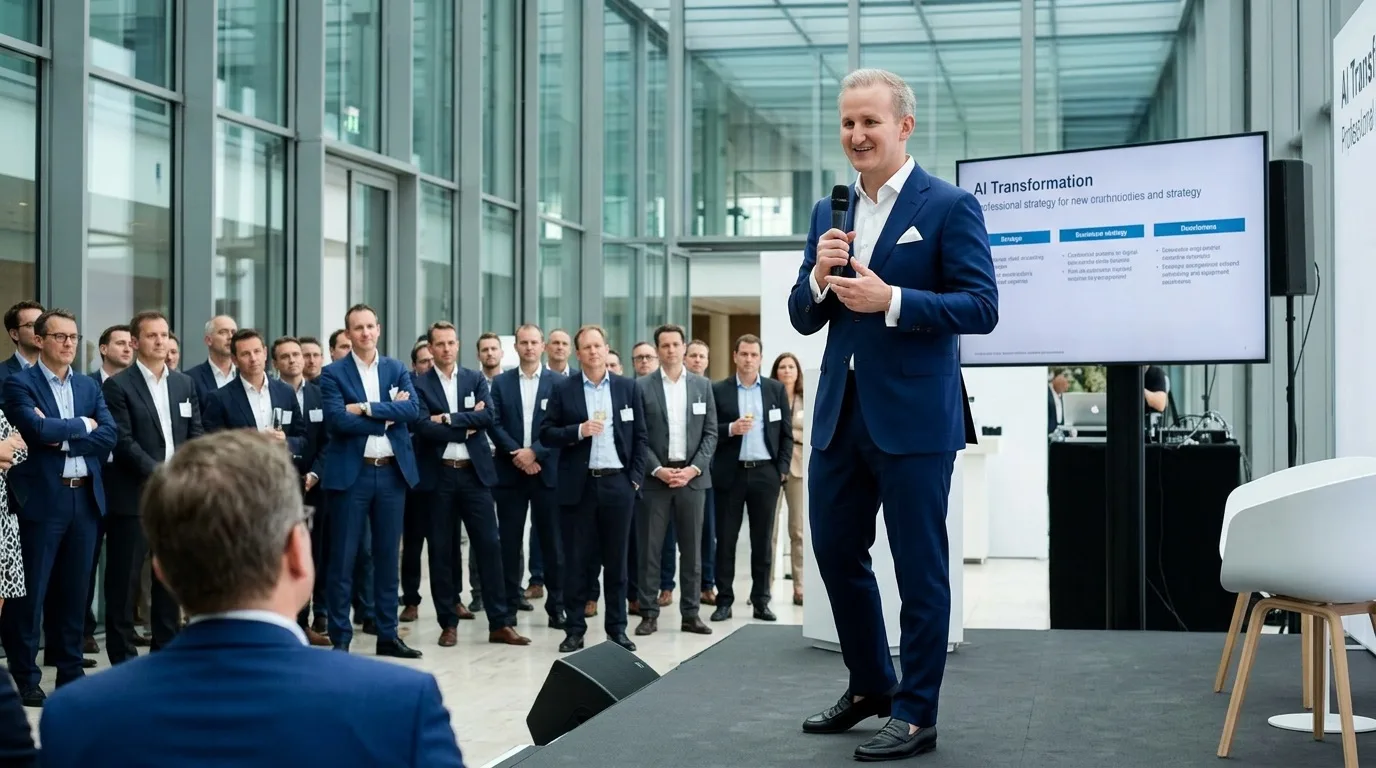
The pressure comes from every direction. The board wants an AI strategy. Competitors automate customer service with chatbots. Your IT department experiments with ChatGPT — no governance, no data strategy, no clear goal.
If you are a managing director or division head caught in this situation, you are not alone. 37% of German companies already use artificial intelligence. But only 5% of global AI investments reach production with measurable returns. The gap between those numbers is where AI consulting creates its value.
This article gives you the knowledge to make an informed decision: When does AI consulting make sense? What happens during a project? What does it cost? And how do you find the partner that fits your organization?
When do companies need AI consulting?
Not every company needs an AI consultant right now. But there are clear signals that it is time.
Five typical triggers
- No ML expertise in-house. Your team knows Excel and BI tools, but nobody can train a machine learning model or evaluate whether a vendor's approach is sound.
- First pilot projects have failed. The chatbot PoC from last year never reached production. The data team spent three months building a model that collapsed in real-world conditions.
- Competitors are moving ahead. Your direct competitor deployed AI-driven pricing optimization. Customers are asking whether you can do the same.
- The board demands an AI strategy. But no one internally can assess which use cases deliver the highest business impact.
- Data exists but sits unused. You have years of ERP data, customer histories and machine logs — without turning any of it into predictions or automation.
When it is too early
AI consulting assumes that fundamentals are in place. If your core processes are not digitized, no structured data exists or there is no budget for implementation after the consulting phase, invest in the basics first. A consultant who sells you an AI project anyway is not acting in your interest.
A machinery manufacturer in southern Germany approached us wanting AI for quality inspection. During the potential analysis, we discovered their inspection protocols were still on paper. Our recommendation: digitize the data capture first, then start a computer vision project six months later. That saved the client 40,000 EUR and half a year of frustration.
What happens in an AI consulting project?
A credible AI consulting project follows four phases. Each phase delivers a clear result. No phase should be skipped.
Phase 1: Potential analysis (2–4 weeks)
The consultant analyzes your business processes, data landscape and IT architecture. The goal: identify where AI delivers the highest business impact. Not where the technology is exciting — where it pays off.
Result: a prioritized list of 3–5 use cases with estimated ROI, data availability and implementation effort.
Phase 2: Strategy and roadmap (2–4 weeks)
The use cases become an AI strategy with a concrete plan. Who does what, by when, with which resources? What governance rules apply? How is success measured?
This is where quality separates from noise. Good consultants deliver a plan your team can execute. Poor ones deliver an 80-page deck that sits in a drawer.
Phase 3: Proof of Concept (4–8 weeks)
The first use case gets built as a prototype — with real data, not demo data. At the end, there is a working system that management and the business team can evaluate.
A concrete example: for a chemicals distributor, we built a RAG system connecting product data sheets with customer queries. The prototype ran after five weeks. The business team could immediately assess whether the response quality was sufficient for customer service.
Phase 4: Rollout and scaling (3–6 months)
The validated prototype moves into production. That means: integration with existing systems (ERP, CRM, email), monitoring, error handling, user training.
Most AI projects do not fail at the prototype stage. They fail at the transition to production. This is exactly where you discover whether your consultant has real implementation experience or just delivers slides.
What does AI consulting cost?
The cost question is fair — and rarely answered clearly. Here are the ranges we see across our projects:
| Project type | Timeline | Investment |
|---|---|---|
| Workshop / Assessment | 1–3 days | 3,000–10,000 EUR |
| Potential analysis + Strategy | 4–8 weeks | 15,000–40,000 EUR |
| PoC / Prototype | 4–8 weeks | 20,000–60,000 EUR |
| Production system with integration | 3–6 months | 50,000–500,000 EUR |
Daily rates for AI consultants in Germany range from 1,200 to 2,500 EUR — depending on specialization, seniority and project scope. Senior consultants with combined AI and SAP expertise sit at the upper end.
When does AI consulting pay off?
The honest answer: not with every project immediately. But the numbers are clear. A mid-sized logistics company invested 35,000 EUR in potential analysis and a PoC for automated order capture. The solution saves 1.5 FTEs per year — roughly 90,000 EUR. Return on investment in under five months.
The alternative comparison: building an in-house AI team costs 250,000–400,000 EUR in year one (two ML engineers at 80–100k salary, infrastructure, tooling, onboarding). That team needs 6–12 months before delivering productively. External AI consulting delivers a first prototype in 4–8 weeks.
Five mistakes that sink AI projects
Over 80% of AI projects fail, according to RAND Corporation. From our project experience, we know the patterns.
1. Starting with technology instead of the business problem
"We want to use ChatGPT" is not a use case. "We want to reduce customer service response time from 48 to 4 hours" is one. Starting with the technology means searching for problems to fit solutions. That gets expensive.
2. No clear use case
"We need AI" appears in every other strategy paper. But without a concrete use case, there is no measurable goal, no ROI model and no proof that the investment is worthwhile. The potential analysis exists precisely for this reason.
3. Underestimating data quality
AI is only as good as the data it works with. 43% of failed AI projects fail because of data quality. Missing fields, inconsistent formats, outdated records — it sounds trivial, but it sabotages every model. A good AI consultant checks data quality in the first project week, not after three months of development.
4. Forgetting change management
The best AI system is worthless if the business team does not use it. We regularly see technically sound solutions fail because nobody involved the end users. Training, communication and gradual rollout are not optional — they are critical to success.
5. Choosing a partner by brand instead of fit
Large consulting firms with well-known names often staff AI projects with junior consultants who are still learning. What matters is not the name on the invoice but who actually works on your project. Ask for the profiles of the project team members — before signing.
Finding the right AI consultant
Partner selection is the most consequential decision in the entire process. Here are the criteria we recommend.
What to look for
- Reference projects in your industry. Ask for concrete project outcomes, not logos on a website.
- Technical depth. A good AI consultant can explain why they recommend RAG over fine-tuning for your use case — and name the alternatives.
- Implementation capability. Strategy without execution is paper. Check whether the partner also has developers and ML engineers on the team.
- Independence. A consultant who only recommends one platform (Azure, AWS, Google) may be selling their partnership, not your best solution.
- Seniority in the project team. Who actually sits in your workshops? Who writes the roadmap? Junior analysts or experienced consultants?
Red flags
- Promises like "guaranteed ROI in 30 days"
- No technical understanding — strategy slides only
- No reference projects you can verify
- Pressure to sign quickly without a potential analysis
- No interest in your data and processes during the first meeting
Three questions for the first meeting
- "Which AI projects have you delivered in our industry — and what was the outcome?"
- "Who exactly from your team will work on our project?"
- "What happens if the potential analysis shows that AI is not the right lever right now?"
The answer to question three reveals the most. A consultant who honestly says "Then we recommend other measures first" deserves your trust more than one who always finds an AI project to sell.
Frequently asked questions about AI consulting
What is AI consulting?
AI consulting guides companies from potential analysis through strategy development to the implementation of AI solutions. The goal: deploy artificial intelligence where it creates measurable business value — not as an end in itself.
What does AI consulting cost?
Between 3,000 EUR for an assessment workshop and 500,000 EUR for a full production system with integration. Most mid-market projects fall between 20,000 and 80,000 EUR for analysis, strategy and prototype.
How long does an AI consulting project take?
From potential analysis to a working prototype: 8–16 weeks. Through to a productive rollout with system integration: 4–9 months. Projects that take longer than a year typically have a scope or governance problem.
What company size makes AI consulting worthwhile?
From around 10–20 million EUR in revenue and at least one process that is data-intensive and repetitive. Company size alone is not decisive — what matters is whether a concrete use case exists that pays for itself.
When the right time for AI consulting is
The right time is not "when we are ready." No company feels ready. The right time is when the pressure to act exists and the data foundation is sufficient to implement a first use case.
AI consulting is not a technology purchase. It is an investment in decision-making capability. Companies that ask the right questions, choose the right partner and start with a concrete business problem turn AI into a competitive advantage. Companies that wait until everyone else has shown the way end up reacting instead of leading.
Facing this decision? We advise mid-sized companies and enterprises on AI adoption — from potential analysis to production systems. Talk to us — we will tell you honestly whether AI is the right lever for your case.