A sales lead asks their AI assistant for last quarter's revenue figures. The assistant reaches into SAP in real time, pulls the numbers, compares them to the prior year and delivers a summary — no one had to build a report. A year ago that was a demo. Today it runs on an MCP server.
The Model Context Protocol has become the de facto standard for connecting large language models with enterprise systems since Anthropic released it in November 2024. Claude, ChatGPT, Gemini, Microsoft Copilot — they all speak MCP. Yet many organizations still struggle with the practical questions: Who builds the server? How does it connect to our ERP? And what does it cost?
This article answers exactly that. No filler, no jargon. Instead: what an MCP server is, when it pays off, how the architecture works and what to look for when you commission MCP server development for your organization.
What Is an MCP Server — and Why Does It Matter Now?
MCP stands for Model Context Protocol. Think of it as USB-C for AI: a single open standard that governs how AI models access external data sources and tools. Any model, any system — one protocol.
An MCP server sits between your business system — SAP, a CRM like Salesforce, an internal database — and the AI model. It translates the model's requests into actions: fetching data, creating records, triggering workflows. Everything runs over a standardized JSON-RPC 2.0 interface.
Why does this matter? Because before MCP, every AI integration was a one-off. Connecting ChatGPT to your ERP required a custom API integration. Connecting Claude to your ticketing system required another. With ten systems and three AI models, you ended up with 30 separate integrations. MCP reduces that to 10 + 3. That's the difference between a cable drawer and a standard power outlet.
Since December 2025 MCP sits with the Linux Foundation under the Agentic AI Foundation. Founding members: Anthropic, OpenAI, Block. Platinum sponsors paying $350,000 per year: AWS, Google, Microsoft, SAP, Salesforce and Bloomberg. This isn't a niche protocol. It's infrastructure.
Why Your Organization Needs an MCP Server
In our AI consulting engagements we see a clear shift since early 2025. The question is no longer "Should we use AI?" — it's "How do we connect AI to our systems without rebuilding everything?"
That is exactly where an MCP server delivers value. Three reasons.
1. From Answers to Actions
Without MCP an AI model can only respond. With MCP it can act. It can pull customer data from your CRM, check an order in your ERP, schedule a meeting or update a Jira ticket. That's the leap from chatbot to AI agent.
2. The N×M Problem Disappears
Every custom integration has a cost. Companies that want to connect three to five AI applications to ten internal systems face 30 to 50 individual interfaces without a standard. With MCP you need ten servers and three clients. Done. Every new system or model adds exactly one connection — not ten.
3. No Vendor Lock-in
Because MCP is open, you're not tied to one AI provider. Claude today, GPT-5 tomorrow, an open-source model next quarter — your MCP server stays the same. That is strategically decisive in a market where power dynamics shift every six months.
MCP in Practice: Three Scenarios We Deliver for Clients
Theory is fine. Results are better. Here are three scenarios that show how MCP servers run in real enterprise environments.
Making SAP Data Accessible to AI Agents
A chemicals distributor in Germany wanted to give its sales team an AI assistant that could answer questions about stock levels, open orders and delivery times in real time. The problem: all that data lives in SAP ECC, and no LLM in the world has direct access to it.
The solution: an MCP server that connects to SAP via BAPIs and exposes the data as structured tools. The AI agent asks the MCP server which tools are available, picks the right one — and delivers the answer in plain language. No report, no transaction code, no SAP training required.
Internal Knowledge Management With MCP
An IT services company with 200 employees had its knowledge scattered across Confluence, SharePoint, a wiki and three different ticketing systems. New hires needed months to find their way around. An MCP server that binds all four sources as Resources lets employees ask a single question — and the AI agent searches every system simultaneously.
Onboarding time for new employees: from three months down to six weeks. The MCP server cost less than half an annual salary.
Automated Document Review in Finance
An audit firm uses MCP to connect AI agents to its document management system. The agent checks incoming receipts for completeness, matches them against booking entries and flags discrepancies. Time saved on VAT filing: roughly one hour per client per month. With 200 clients, the math works.
How an MCP Server Is Built
If you plan to commission MCP server development, it helps to understand what happens under the hood. You don't need to be a developer to follow the architecture.
The Three Layers
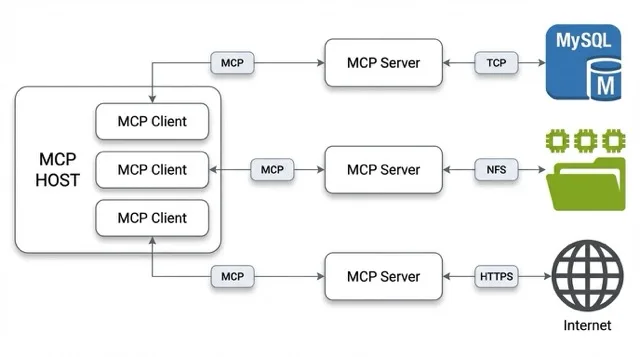
MCP follows a client-server architecture with three roles:
- Host: The application the user sees — Claude Desktop, Cursor, or an internal chat tool. The host manages connections and permissions.
- Client: Lives inside the host and maintains a 1:1 connection to one MCP server. Each client talks to exactly one server.
- Server: Exposes tools, resources and prompts. This is the part you build (or have built). It accesses your systems and delivers data to the client.
Tools, Resources and Prompts
An MCP server can expose three types of capabilities:
- Tools — executable functions. Example:
get_customer_orders(customer_id)orcreate_support_ticket(title, priority). The AI model decides autonomously when to call a tool. - Resources — readable data sources. Example: a Confluence page, a PDF, a database view. The client can query resources without changing anything.
- Prompts — reusable templates. Example: a standard prompt for sales analysis that always follows the same structure.
Communication runs over JSON-RPC 2.0 — either locally via stdio or remotely via Streamable HTTP with Server-Sent Events. For enterprise setups we recommend Streamable HTTP because it handles firewalls and proxies more reliably.
Build It Yourself or Commission MCP Server Development?
The honest answer: it depends. But after twelve months of MCP in production environments, clear patterns have emerged.
Building In-house Works When…
- Your dev team has experience with Python or TypeScript
- The use case is straightforward (one system, one tool, one data source)
- You can adapt an existing open-source server (there are over 10,000 on GitHub)
- You have the time to handle security and permissions yourself
Commissioning MCP Server Development Pays Off When…
- You need to connect multiple systems (SAP + CRM + ticketing + database)
- Sensitive data is involved (financial records, HR data, customer data)
- Compliance requirements apply (GDPR, ISO 27001, audit logging)
- The MCP server needs to run in production — not just as a prototype
- You don't have an internal AI team or need it for other priorities
The bottleneck is rarely the MCP server itself. A simple server exposing one tool can be built in a day. But a production-grade server with authentication, error handling, logging, role-based access control and monitoring — that is a different project.
In our experience with AI projects for mid-market companies, most in-house builds don't fail because of the code. They fail because of an architecture decision that nobody can trace three months later. Or a security gap that only surfaces after go-live.
Security and Compliance: What to Watch For
MCP gives AI agents access to enterprise systems. That's powerful. And that's exactly why security is not optional — it's the first requirement.
OAuth 2.1 Instead of API Keys
The MCP specification prescribes OAuth 2.1 with PKCE for authentication. In practice, however, 53 percent of all MCP servers still use insecure static API keys, according to an analysis by Astrix Security. That's negligent — especially when personal or financial data is at stake.
We implement OAuth 2.1 with token rotation and scope-based access in every MCP project. The AI agent gets access only to the data it needs for its current task. Nothing more.
Least-Privilege Principle
Every tool in the MCP server gets its own permissions. A sales agent may read customer data but not cancel invoices. An HR agent may summarize applications but not view salary records. That sounds obvious — but in the majority of MCP implementations we review in audits, this concept is missing entirely.
GDPR Compliance
For companies in the EU, clear rules apply:
- Data minimization: The MCP server passes only the data the agent actually needs — no full datasets "just in case."
- Logging and traceability: Every access is recorded. Which agent accessed what data, and when? That's not just a GDPR obligation — it's your safety net.
- Data residency: When the MCP server runs on European infrastructure, personal data stays within the EU — even if the AI model is hosted in the US.
- Legal basis: AI agent access to personal data requires a legal basis under Art. 6 GDPR — typically legitimate interest or contract performance.
What Does MCP Server Development Cost?
The question everyone asks — and no one can answer with a flat rate. But here are reference figures from our projects.
Proof of Concept (2–4 Weeks)
A PoC that connects one system via MCP and exposes two to three tools. Typical for a first test with SAP, a CRM or an internal database. Investment: €8,000 to €15,000. This isn't throwaway code — it's production-grade and reusable.
Production Setup (6–12 Weeks)
Multiple systems, OAuth authentication, role-based access, monitoring and deployment. The full package. Investment: €25,000 to €60,000, depending on the number of connected systems and tool complexity.
Comparison: Traditional API Integration
Without MCP, a single custom integration between an AI model and an enterprise system typically costs €5,000 to €15,000 with two to six weeks of development time. Across ten systems that's €50,000 to €150,000. With MCP you pay for server development once — and every additional AI application reuses the same servers. Most organizations hit break-even at the third or fourth integration.
Ongoing Costs
Hosting, monitoring and maintenance of an MCP server typically run €200 to €800 per month — depending on whether you run cloud or on-premise. That's less than a single software license for most middleware products.
Conclusion: MCP Is No Longer an Experiment
The Model Context Protocol went from an Anthropic project to an industry standard in 15 months. AWS, Google, Microsoft, SAP — they've all committed. For enterprises that means: investing in MCP today means building on the standard that will define AI infrastructure tomorrow.
Whether you build an MCP server yourself or commission its development depends on your team, your systems and your timeline. What's clear: organizations that make their systems MCP-ready now will ship AI projects in weeks instead of months a year from now.
Want to know what an MCP server for your systems could look like? We've delivered MCP projects for mid-sized companies and large enterprises — from SAP integrations to multi-system setups. Get in touch — we'll show you what makes sense for your case in a short conversation.