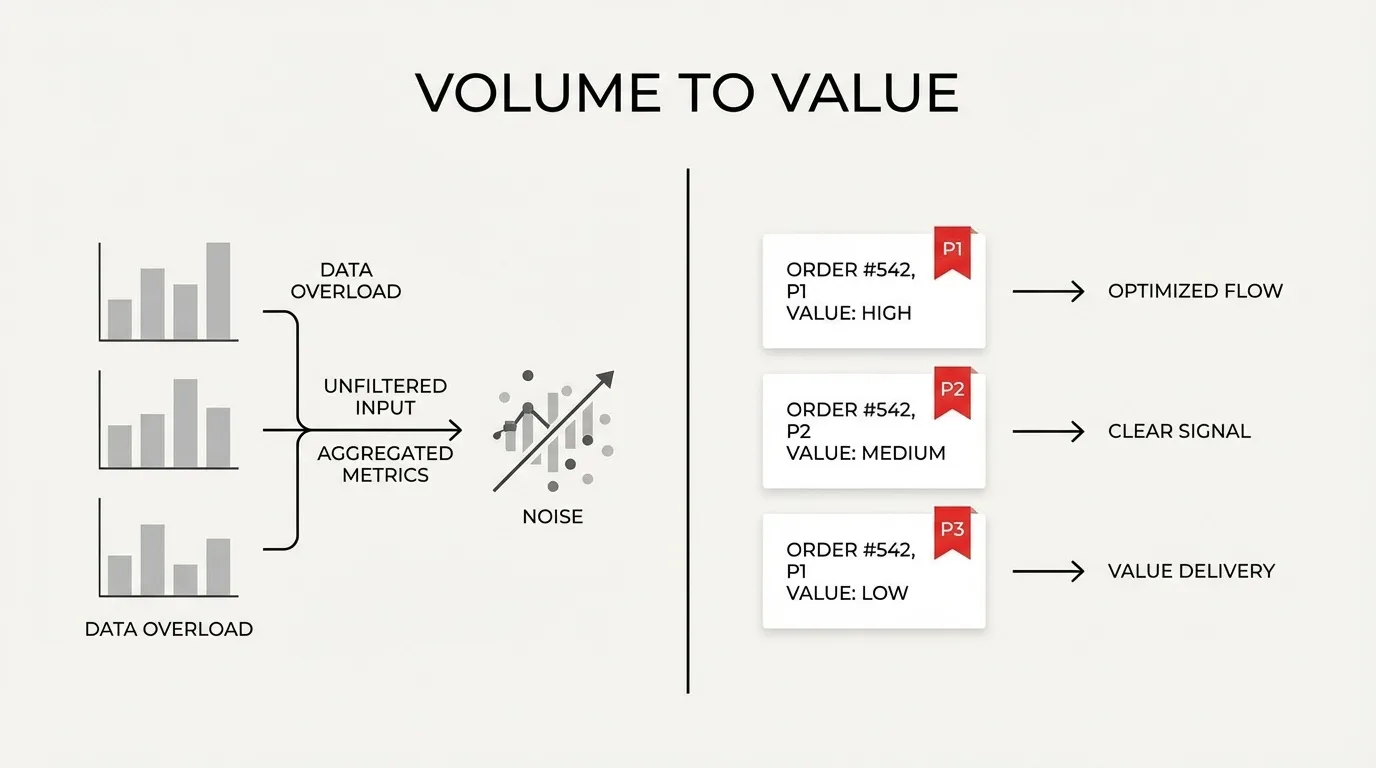
A production manager at an automotive supplier faces a decision: accept a large order from a premium customer — or fulfill three smaller orders with better margins? The planning system shows 87 percent capacity utilization. Looks feasible. But which machine is the bottleneck? Which material is actually short? And what happens to the other three orders if the large one gets bumped up?
Classic S&OP doesn't answer these questions. The answer sits in SAP IBP — specifically in the Order-based Planning capability within Response and Supply. We have been deploying SAP IBP in client projects for several years, and the pattern is consistent: companies that move from aggregate planning to order-level planning make better decisions. Faster. With less risk.
Why aggregate planning hits its limits
Monthly or weekly planning at an aggregate level has its place. It answers the basic question of whether supply and demand roughly align. What it does not answer is the question that actually matters to management: Which specific order do we accept — and which do we decline?
This is not a theoretical problem. A manufacturing client told us that their planning team spent four to six hours every week breaking aggregate plan data down to individual orders by hand. Four to six hours where no decision was made — just arithmetic.
In volatile markets with supply shortages, fluctuating raw material prices and short-notice customer demands, the volume view is no longer sufficient. The real management question is: How do we steer value creation under real-world constraints?
What Order-based Planning in SAP IBP does differently
Order-based Planning in the Response and Supply module of SAP IBP shifts the focus. Away from "How much do we produce next week?" — toward "Which order do we fulfill, at what priority, under which constraints?"
That sounds like a small distinction. It is not. Moving from volume-based to order-based planning changes the entire decision logic across the supply chain. The center of attention shifts from aggregates to individual customer commitments and their concrete value to the business.
In one of our consulting projects for a chemicals distributor, this shift cut the weekly planning review from three hours to 45 minutes. Not because less was discussed — but because the right information was available at order level.
Visibility into real constraints
Aggregate capacity utilization is an average. It hides more than it reveals. 85 percent utilization can mean: Line A runs at 100 percent, Line B at 70. The bottleneck sits on Line A — but you only see that when you plan at order level.
SAP IBP with Order-based Planning makes real constraints visible:
- Which production capacity is actually blocked?
- Which materials are genuinely scarce — not just according to the forecast?
- Which transport routes limit delivery capability?
For management, this is a fundamental shift. Bottlenecks stop being abstract KPIs. They become specific steering points where decisions can be anchored. A supply chain director we work with put it this way: "For the first time we see not just that something is tight — but exactly where and why."
Prioritization as a strategic lever
Not every order carries the same value. Every salesperson knows this. But in many planning systems, orders are processed on a first-come-first-served basis. That makes operational sense. Strategically, it is negligent.
With Order-based Planning in SAP IBP, decisions follow defined business logic:
- Revenue and margin impact — Which order delivers the highest contribution margin?
- Customer value and contractual obligations — Prioritize key accounts when capacity gets tight
- Market or product priorities — Strengthen new markets even if individual order sizes are smaller
- Long-term growth targets — Protect strategic customers instead of letting a high-margin spot order take precedence
When constraints bind, the system does not decide randomly. It prioritizes along the rules management has defined. Planning becomes an instrument of corporate strategy — not just operational scheduling.
A concrete example: a client manufacturing industrial components faced a situation where a raw material supplier cut deliveries by 30 percent. Without Order-based Planning, the planning team would have had to decide manually which orders to delay. With SAP IBP, the re-planning ran within two hours — prioritized by contractual penalties and customer classification.
Speed without losing control
SAP IBP connects to SAP S/4HANA through cloud integration. Changes in order management — a new order, a cancellation, a material shift — immediately affect the planning view.
This addresses three problems we hear in nearly every client conversation:
- Decision delays — Because the data is current, not three days old
- Coordination loops — Planning and order management work from the same information base
- False commitments to customers — Delivery promises are based on actual availability, not stale forecasts
Speed here does not come from improvisation. It comes from transparency. That distinction is something many companies only truly grasp after going live with SAP IBP.
Simulation before commitment
One of the strongest capabilities in SAP IBP: making consequences visible before a decision takes operational effect.
Typical management questions that simulation can answer:
- What happens if we pull a large order forward by two weeks?
- Which existing customers would we have to push back?
- What additional costs arise from alternative scenarios — overtime shifts, express deliveries, spot material purchases?
Instead of gut feeling, the system provides defensible decision data. In a project for a packaging machinery manufacturer, the simulation capability led management to decline a seemingly attractive rush order — because the simulation showed that knock-on costs would have exceeded the profit. Without that transparency, the order would have been approved without question.
Strategic impact in practice
We recommend Order-based Planning in SAP IBP especially for companies that match at least one of these profiles: high order variability, constrained capacity, or a customer structure with widely differing value contributions.
The effects we observe across our projects:
- Higher delivery reliability — Because bottlenecks are detected and prioritized early. One mechanical engineering client raised on-time delivery from 82 to 94 percent within six months.
- Better protection of high-margin revenue — Because the system prioritizes along business rules, not arrival sequence
- Greater resilience under disruption — Because alternative scenarios can be calculated in minutes rather than days
Supply chain planning turns from a supporting process into an active steering function. That is the real value contribution of SAP IBP — not the software itself, but the decision-making capability it enables.
When the investment pays off
SAP IBP with Order-based Planning is not a tool for organizations that want to "see what's possible." It is built for companies that treat their supply chain as a strategic differentiator and manage it accordingly.
The investment pays off when the limits of aggregate planning become tangible: too many manual alignment meetings, too slow a response to disruptions, too little control over constraint allocation. In our experience from IBP projects, the majority of clients achieve return on investment within twelve months — measured in saved planning time, avoided false commitments and improved margin protection.
Facing a similar situation? We advise mid-sized companies and enterprises on SAP IBP adoption — from requirements analysis through to productive operation. Get in touch — we will show you what Order-based Planning could look like in your supply chain.